

Hunter Arms “The Fulton” .410 Bore SxS Shotgun Selling at Two Alpha Auctions on September 26th, 2026
Short answer: You have four realistic options — consign to a specialty firearms auction, sell outright to an FFL dealer, sell privately, or list online yourself. Auction consignment generally returns the most money on collectible, antique, vintage, and premier firearms because it puts your guns in front of a national buyer pool competing against each other. Dealer buyouts are fastest but pay roughly 50–70% of market value. Private sales in Michigan require a License to Purchase or CPL from your buyer for every firearm, including rifles and shotguns, since February 2024.
Two Alpha Auctions is a licensed FFL auction house in Marshall, Michigan. We research, inspect, grade, photograph, and market firearms for individuals, families, and estates across the country — from single guns to entire collections. [Request a free evaluation →]
Table of Contents
Before You Do Anything Else
What Actually Determines What Your Firearms Are Worth
How Firearms Are Graded
Your Four Options for Selling
Michigan Firearm Sale Laws
Selling Inherited Firearms and Estate Collections
How Two Alpha Auctions Works
Frequently Asked Questions
1. Before You Do Anything Else
Do not clean, polish, or refinish anything
This is the most expensive mistake sellers make, and it is almost always made with good intentions.
Firearm value is driven substantially by percentage of original factory finish remaining. A wire brush, a scouring pad, a bottle of bluing touch-up, or an enthusiastic hand with steel wool permanently removes original finish. So does refinishing a stock.
A collectible firearm that would have graded Excellent with 95% original blue can drop to a fraction of its value the moment someone "cleans it up." The rust you removed was worth less than the finish you took with it.
What you should do: nothing. Leave the dust, leave the patina, leave the honest wear. If a firearm is actively rusting and you're worried about further damage, call us before you touch it. There are conservation approaches that preserve value; household cleaning is not one of them.
The same applies to:
Refinishing or sanding stocks
Replacing "worn out" grips with new ones
Removing an old scope or mount to make the gun "original"
Polishing brass, silver inlay, or engraving
Throwing away the "junk" box the gun came in
Keep everything together
Original boxes, papers, manuals, hang tags, factory letters, receipts, spare magazines, tools, cleaning rods, extra chokes, and cases all add value — sometimes substantial value. An original numbered box matched to its firearm can add a meaningful premium on its own.
Do not separate accessories from the gun they belong to. If a scope has been on that rifle for forty years, leave it there and let us evaluate whether it should be sold together or separately.
Secure and inventory the collection
Before you contact anyone, build a working list. For each firearm, record:
Make and model, exactly as marked
Caliber or gauge
Serial number
Barrel length
Any obvious condition notes
Photographs — the whole firearm from both sides, plus close-ups of the serial number, all markings and stamps, any engraving, and any damage
Photograph in even, indirect light. Avoid direct flash, which hides pitting and flattens finish.
This inventory protects you regardless of how you eventually sell, and it lets any professional give you a far more accurate preliminary opinion.
Handle safely
Every firearm is treated as loaded until you have personally verified otherwise. Check the chamber and the magazine. If you are not comfortable or not familiar with the action type, stop and let a professional handle it. This is especially true with inherited collections, where guns are frequently found loaded and stored that way for decades.
When transporting firearms to any dealer, shop, or auction house, they should be completely unloaded, cased, and using chamber flags where possible.
2. What Actually Determines What Your Firearms Are Worth
Sellers are often surprised by which guns carry value and which do not. A worn-looking old rifle in the back of the closet can be worth many multiples of the clean modern pistol sitting next to it.
Value comes from the interaction of several factors:
Condition. The single largest driver, and the least intuitive. See §3 below.
Originality. Matching serial numbers, original parts, original configuration, original finish. A refinished or modified firearm is worth materially less than an original one in the same apparent condition — and a trained eye spots refinishing quickly.
Rarity and variation. Production numbers, factory options, barrel lengths, chamberings, and one-year-only features. Two firearms that look identical to a layperson can differ enormously in value based on a variation visible only to a specialist. This is where most non-specialist sellers leave money on the table.
Manufacturer and model desirability. Colt, Winchester, Smith & Wesson, Parker, Browning, Luger, Marlin, and others carry collector followings. So do specific models within otherwise ordinary brands.
Provenance and documentation. Factory letters, military attribution, documented ownership history, and period paperwork can transform a firearm's value.
Completeness. Box, papers, and accessories, as above.
Market timing and audience. The same firearm brings different results in front of different buyer pools. Placing a gun in the right venue at the right time is a substantial part of what a specialist auction house is actually being paid to do.
3. How Firearms Are Graded
Condition grading is the language of the firearms market. Understanding it will help you evaluate any offer you receive, from anyone.
Two Alpha grades using published NRA condition standards, refined with an era-based sliding scale drawn from the collecting literature. There are two separate scales, and knowing which one applies to your firearm matters.
Why the grade moves the money so much
A single grade step is not a small adjustment. Consider a Colt Python:
Graded Fair — estimated around $800
Graded Good — estimated upwards of $1,900
Same firearm. One grade apart. More than double the money.
This is why a careless or rushed grade — in either direction — is a serious problem, and why we grade conservatively and review internally before anything goes to market.
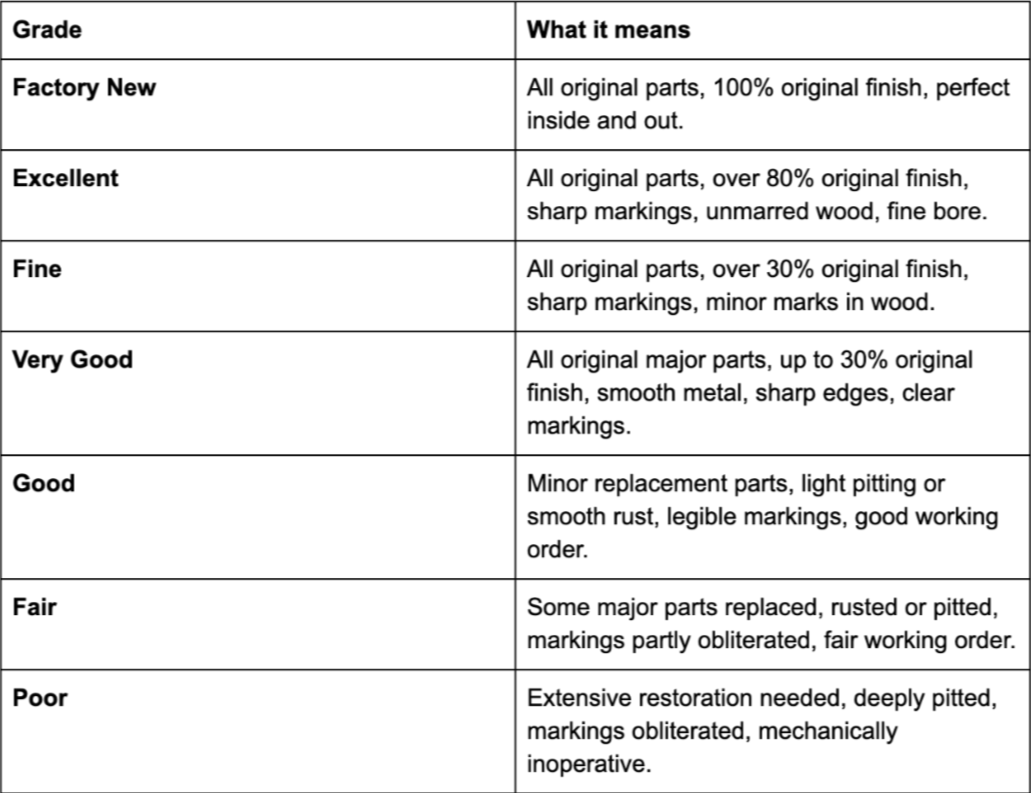
Modern firearm grades:

Modern Firearm Grades
Antique firearm grades
Applies to firearms manufactured in or before 1898, and to design families that antique collectors evaluate by these terms — black powder arms, tip-up and top-break revolvers, trapdoor and single-shot military rifles, and similar.
Antique Firearm Grades
Percentage of original finish
Beyond the word grade, we estimate and publish the percentage of original finish remaining on metal surfaces. This is the figure most collector price guides actually run on, and it is far more precise than a one-word grade.
Two important points sellers should understand:
The percentage refers to original factory finish. A refinished gun is not rated on this scale — it gets described separately and honestly, because pricing a refinished gun off original-finish comparibles is how buyers get misled and sales get unwound.
Expectations slide by era. A post-1945 firearm generally needs roughly 98% original blue to be called Excellent. An 1865–1890 firearm needs closer to 85%. Collectors apply this scale instinctively; we apply it explicitly.
What else gets graded and described
A responsible condition report is not one word. Every firearm we catalog is described across:
Bore condition: mirror, bright, frosted, pitted, or dark, with rifling strength noted
Metal finish: type and condition, receiver and barrels described separately when they differ
Stock, grip, and forend: material, style, finish, cracks, repairs, refinishing, checkering wear
Sights and optics: type, make, model, mounts
Mechanical condition: what we observed on inspection
Faults and inconsistencies: pitting, rust, cracks, cycling problems, replaced parts, import marks
Chamber and choke: for shotguns, each barrel recorded separately
Date of manufacture and C&R eligibility: where verifiable
We describe what we see, not what a reference book says the model should have. And we never represent any firearm as safe to fire — we describe condition and recommend inspection by a qualified gunsmith.
The rule we grade by
When in doubt, we assign the lesser grade and flag the firearm for a second reviewer.
This protects both sides. An overstated grade means an unhappy buyer and a returned lot. An understated grade means a seller who got shortchanged. Neither is acceptable, so anything uncertain gets a second qualified set of eyes before it goes to market.
4. Your Four Options for Selling
Option A: Specialty firearms auction and consignment — highest return
Best for: collections of any size, estates, and any firearm that is rare, antique, vintage, collectible, or premier. Also strong for common firearms sold in a well-marketed sale.
A specialty firearms auction house handles cataloging, research, photography, marketing, background checks, secure storage, transfer compliance, and shipping. You receive the proceeds less a commission. Industry fees commonly run in the 15–20% range, though a good house will structure fees around what you actually have (more on that below).
Why it usually returns the most:
Competition sets the price. Rather than negotiating against one buyer who profits by paying you less, you have a national pool of collectors bidding against each other.
The right buyers actually see it. A rare variation is only worth its premium if someone who recognizes it is in the room. Specialty houses have the collector audience; general estate sales and local shops usually don't.
Research uncovers value. Correct identification of a variation, a factory option, or a provenance detail can multiply a result. This only happens if someone looks.
Compliance is handled. Transfers, background checks, state paperwork, and interstate shipping are the auction house's responsibility.
Trade-off: it takes longer than a cash buyout. Cataloging, marketing, the sale itself, and settlement typically span several weeks to a few months depending on the sale calendar.
Option B: Bulk buyout from an FFL dealer — fastest cash
Best for: sellers who need immediate money, or collections of common, modern, high-turnover firearms.
You sell the collection outright to a licensed dealer and walk out with a check. Expect roughly 50% to 70% of market value — the dealer is assuming the cost, risk, and time of resale, and that spread is their margin.
This is a legitimate and appropriate choice when speed matters more than maximum return. It is a poor choice for anything rare or collectible, because you are selling to the one person in the transaction who knows exactly what it's worth.
Contact us for a list of Michigan dealers with buyback operations.
Option C: Private sale — highest effort and risk
Best for: one or two common firearms, sold to someone you know, when you are comfortable managing the legal requirements yourself.
You handle every transaction individually: finding buyers, verifying eligibility, completing paperwork, and managing the meeting. You keep the full sale price, but you also carry the full liability.
See §5 for what Michigan requires. Read it carefully — the rules changed in 2024 and a great deal of outdated guidance is still circulating online.
Risks to understand: you are personally responsible for not transferring a firearm to a prohibited person. You are exposed to scams, no-shows, and meeting strangers. And you will likely undersell anything collectible, because private buyers are not the specialist audience.
Option D: Online marketplaces — moderate return, all the work
Best for: individually valuable, easily described modern firearms, when you have the time.
Firearm-specific marketplaces reach a national audience, but you handle photography, description, listing fees, buyer questions, payment, FFL coordination, and shipping — and every listing must transfer through an FFL. Fees, time, and the risk of a poor description stack up quickly.
Quick comparison

5. Michigan Firearm Sale Laws
This section is general information, not legal advice. Michigan firearm law changed in February 2024 and has been further clarified since. A large volume of outdated guidance remains online — including in AI-generated search summaries. Requirements below reflect Michigan law as of January 2026. Verify with the Michigan State Police Firearms Records Unit or your local law enforcement agency before completing any private transaction.
The change most sellers still don't know about
PA 19 of 2023 took effect February 13, 2024. Before that date, private long gun sales in Michigan required no permit. That is no longer true.
Under current law, a private buyer of any firearm — pistol, rifle, or shotgun — must either hold a valid Michigan Concealed Pistol License (CPL) or first obtain a License to Purchase (form RI-010a) from their local police department or sheriff's office.
If you have read anywhere that Michigan long guns still change hands privately with no permit, that guidance predates February 2024. A great deal of it is still online.
The Two Forms
RI-010a — License to Purchase (LTP). Obtained by the buyer before the sale. A valid Michigan CPL takes its place.
RI-060 — Firearms Sales Record. Completed at the time of transfer.
Which form applies, who submits it, and to which jurisdiction depends on the combination of seller type, firearm type, and whether the buyer holds a CPL. The jurisdiction detail catches people out — read it closely.
Private Sale (non-FFL seller)
PISTOL — buyer HAS a CPL The seller completes the Firearms Sales Record (RI-060) and submits it to the seller's jurisdiction.
PISTOL — buyer does NOT have a CPL The buyer must first obtain the LTP (RI-010a). The seller completes it and submits it to the issuing jurisdiction — the agency that issued the LTP, not the seller's own. No RI-060 is involved in this scenario.
LONG GUN — buyer HAS a CPL The seller completes the Firearms Sales Record (RI-060). No paperwork submission is required after the sale.
LONG GUN — buyer does NOT have a CPL The buyer must first obtain the LTP (RI-010a). No paperwork submission is required after the sale.
Two patterns worth holding onto: pistols generate a filing obligation, long guns do not. And in every private pistol scenario, the seller carries the submission duty — but where it goes flips depending on whether the buyer has a CPL. CPL: seller's jurisdiction, RI-060. No CPL: issuing jurisdiction, RI-010a, no RI-060.
Sales through an FFL
PISTOL — buyer HAS a CPL Seller submits the completed RI-060 to the seller's jurisdiction. The FFL may run a NICS check but is not required to.
PISTOL — buyer does NOT have a CPL The buyer must first obtain the LTP (RI-010a). The seller submits the completed license to the issuing jurisdiction. The FFL may run a NICS check but is not required to.
LONG GUN The seller completes the RI-060. No paperwork submission is required after the sale. The FFL is not required to run a NICS check on buyers holding a CPL or LTP.
If you're working from a chart printed in early 2024, check it against this. The rule that an FFL must run NICS on these transactions has changed — it is now permissive where the buyer holds a CPL or LTP.
FFL dealers must otherwise complete an RI-060 or RI-010a for their transactions, except where the purchaser holds a qualifying out-of-state permit. FFL-to-FFL transfers are entirely exempt from Michigan registration requirements under MCL 28.422(7).
The out-of-state carry permit exception
A buyer holding a valid concealed carry license issued by another state is exempt from obtaining a Michigan License to Purchase and from submitting registration paperwork. Where this exception applies, a private seller is exempt from submitting the RI-060.
Two conditions and one hard limit:
The buyer must be a resident of the state that issued the permit. A permit from a state the buyer doesn't live in does not qualify.
The exception does not waive NICS. Buying from an FFL, an out-of-state permit holder still gets a federal background check — state-of-issuance rules under the Brady Act and ATF regulations mean the permit only substitutes for the Michigan LTP, not for the federal check.
A Michigan FFL may not transfer a handgun directly to a non-resident permit holder. The handgun must be transferred to an FFL in the purchaser's state of residence.
The federal trap that catches private sellers
This is the single most dangerous gap in Michigan firearm sales, because state law and federal law do not line up.
Michigan law permits a non-FFL seller to transfer to a non-resident buyer. Federal law does not. The Gun Control Act strictly prohibits transferring, selling, or gifting a handgun to a resident of another state.
A private seller who follows the Michigan chart correctly and hands a pistol to an out-of-state buyer has satisfied state law and committed a federal offense. Michigan's rules being met is not a defense.
Any handgun going to an out-of-state buyer must route through an FFL in that buyer's state of residence. No exceptions.
NFA items
Suppressors, short-barreled rifles and shotguns, machine guns, and other NFA items are excluded from the long gun rules above. They follow their own federal transfer process requiring ATF approval and tax stamps, and must be handled by a licensed entity. Do not attempt an NFA transfer privately.
Other Michigan requirements
Buyers must meet state and federal age requirements.
You may not transfer a firearm to anyone you know or have reason to believe is prohibited from possessing one.
Keep documentation. A signed bill of sale listing serial numbers proves you are no longer the owner of that firearm — this matters enormously if a gun you sold later surfaces in an investigation.
Procedures and local practice vary by agency. Confirm with the relevant jurisdiction.
Federal and interstate rules
Any handgun sale to a resident of another state must route through an FFL in the buyer's state. There is no lawful private interstate handgun transfer.
Firearms shipped across state lines must be shipped to an FFL.
Antique firearms manufactured in or before 1898 are treated differently under federal law. Do not assume a gun qualifies because it looks old — legal antique status depends on the actual manufacture date of the frame or receiver, and getting it wrong is a serious problem.
How this works when you consign
Auction companies and third-party sellers occupy an unusual position. Acting as a fiduciary for the actual seller, an auction house takes possession of a firearm without taking title to it. MCL does not explicitly address this arrangement.
Two Alpha's practice is to submit the RI-060 on transfers we handle — the conservative reading, and the one that leaves a complete record. We would rather file a form that arguably wasn't required than leave a gap in a firearm's chain of custody.
When you consign to a licensed FFL auction house, all of the above becomes our responsibility rather than yours — the forms, the jurisdictions, the deadlines, the federal interstate rules, and the NFA process. Given that the state and federal rules genuinely conflict on out-of-state handgun sales, that transfer of risk is a substantial and often underappreciated part of what consignment actually buys you.
6. Selling Inherited Firearms and Estate Collections
Inherited collections carry complications that ordinary sales do not.
You may not know what you have. Collectors rarely leave inventories. A collection assembled over decades often contains firearms the family has no idea are significant. We regularly find that the guns the family assumed were valuable are ordinary, and the one nobody thought about is the piece that carries the sale.
Guns may be loaded, deteriorating, or improperly stored. Long-term closet and safe storage produces rust, dry rot, and stuck actions. Guns are frequently found loaded.
There may be estate, tax, or division requirements. Executors often need a documented, defensible valuation — for probate, for insurance, or simply so that heirs can divide an estate fairly without argument.
There may be paperwork issues. Missing registration records, firearms registered to the deceased, and NFA items in an estate all require specific handling.
Two Alpha works regularly with families, executors, attorneys, and estate professionals. We can travel to inventory a collection in place, provide written evaluations suitable for estate purposes, handle transport, and manage the entire disposition. If part of the collection is being retained by family and part sold, we work with that too.
7. How Two Alpha Auctions Works
We are a licensed FFL auction house in Marshall, Michigan, operating under the personal brand The Sporting Auctioneer and continuing the Belcher Auction Company legacy established in 1919. Our team brings nearly two decades of firearms auction, appraisal, and FFL compliance experience.
We research and inspect every firearm
Every firearm we take in is physically inspected, function-checked, measured, and researched. We identify variations, verify manufacture dates, check for refinishing and replaced parts, evaluate bores, and confirm markings against reference sources.
This is the step most sellers never get anywhere else, and it is where value is either found or lost. A correctly identified variation, a verified factory configuration, or a documented provenance detail can change a result by a wide margin. A missed one costs you the difference silently — you will never know what you didn't get.
We offer firearms evaluations
Whether you have one firearm or eight hundred, we will evaluate what you have and tell you honestly what it is worth and what the realistic paths to market are. If the best answer for your situation is not consigning with us, we will tell you that too.
Request an evaluation through our firearms consignment process, or contact us directly to arrange an in-person appointment or a site visit for larger collections.
We handle rare and common alike
We have the specialist knowledge to properly catalog, research, and market rare, collectible, vintage, antique, and premier firearms — the pieces that require expertise to identify and the right audience to sell. Engraved guns, factory-lettered pieces, historically significant arms, high-grade doubles, and documented collections are squarely in our wheelhouse.
We also handle common, modern, and utility firearms properly rather than treating them as an afterthought. Most estates contain both, and a house that only wants the highlights is not much use to a family trying to settle an entire collection.
We select the marketing avenue to fit the firearm and the seller
Not every firearm belongs in the same sale, and not every seller wants the same outcome.
We procure specialized avenues to market firearms based on three things: the firearms themselves, the seller's wants, needs, and expectations, and what makes the most financial sense for that seller. A premier collectible may warrant a different venue, timeline, and marketing investment than a group of field-grade shotguns. A seller who needs settlement by a certain date has different constraints than one optimizing purely for maximum return.
We tell you which we recommend and why, and the decision is yours.
We tailor fee structures
Fee structures are built around the collection or firearms a person has — not applied from a fixed rate card regardless of what you brought us. The economics of a single high-value collectible differ from those of a two-hundred-gun estate, and our terms reflect that. We will discuss specific terms with you as part of your evaluation.
We catalog to a published standard
Every lot is cataloged against written internal standards governing grading, description order, terminology, and photography. Our condition reports are built on NRA condition standards refined with an era-based sliding scale, and every firearm is described across bore, finish, stock, sights, mechanical condition, and faults — in that order, every time, by every cataloger.
We photograph professionally, in a controlled studio environment, with consistent lighting. Every defect we describe is visible in a photograph.
What consigning with us looks like
Contact us for an evaluation- online, by phone, or in person.
We evaluate. For larger collections we come to you.
We agree on terms venue, timeline, reserves where appropriate, and fee structure.
We take custody and handle transport and secure, insured storage.
We research, inspect, grade, catalog, and photograph every firearm.
We market through the channels selected for your firearms.
The sale runs.
We handle all transfers, background checks, compliance, and shipping.
You are paid.
8. Frequently Asked Questions
How do I sell a large collection of firearms in Michigan? For collections of any meaningful size, consigning to a specialty firearms auction house generally produces the highest return, because your firearms are researched, properly cataloged, and placed in front of a national pool of collectors bidding against one another. The auction house handles cataloging, marketing, background checks, transfers, and shipping. Faster alternatives — selling the collection outright to an FFL dealer — typically return 50–70% of market value.
Do I need a license to sell my own firearms in Michigan? Selling firearms from your personal collection does not require an FFL. However, under PA 19 of 2023, effective February 13, 2024, a private buyer of any firearm in Michigan must hold a valid Michigan CPL or first obtain a License to Purchase (RI-010a). For private pistol sales the seller carries the filing duty: if the buyer has a CPL, the seller submits the RI-060 to the seller's own jurisdiction; if the buyer does not, the seller submits the completed RI-010a to the jurisdiction that issued it, and no RI-060 is involved. Repeatedly buying and selling firearms for profit does require a federal license.
Can I sell a rifle or shotgun privately in Michigan without a background check? Not without a permit. PA 19 of 2023, effective February 13, 2024, extended the requirement to long guns. Your buyer must hold a valid Michigan CPL or first obtain a License to Purchase (RI-010a). The paperwork differs from pistols — a private long gun sale generates no submission requirement after the sale — but the buyer still needs a CPL or LTP before taking possession. Guidance stating otherwise predates the law change.
How much are my old guns worth? It depends heavily on condition, originality, rarity, and specific variation — and small differences drive large value gaps. A single condition grade can more than double a firearm's value. The only reliable answer comes from a physical inspection by someone who knows the model. Two Alpha provides firearms evaluations for collections and individual guns.
Should I clean my guns before selling them? No. Cleaning, polishing, or refinishing removes original factory finish, which is one of the largest drivers of collector value. Sellers routinely destroy significant value trying to make firearms look better. Leave them as they are and let a professional assess them.
What is my firearm's condition grade? Firearms are graded on two scales — modern and antique — using terms including New, Excellent, Fine, Very Good, Good, Fair, and Poor. The grade depends on original finish remaining, originality of parts, bore condition, and mechanical function, with expectations sliding by production era. See §3 above.
How long does it take to sell firearms at auction? Typically several weeks to a few months from consignment to settlement, depending on cataloging time and the sale calendar. If you need immediate cash, a dealer buyout is faster but returns substantially less.
What does a firearms auction house charge? Industry commissions commonly run 15–20%. Two Alpha structures fees around the specific collection or firearms consigned rather than applying a fixed rate to every seller.
Can you sell firearms I inherited? Yes. We work regularly with families, executors, and estate attorneys. We can inventory a collection in place, provide written evaluations for estate and probate purposes, arrange transport, and handle the full disposition.
Do you handle NFA items? Yes. Suppressors, short-barreled rifles and shotguns, and other NFA items require ATF-approved transfers and must be handled by a licensed entity.
Can I sell a handgun to someone from another state? Not privately, and this is where sellers get into serious trouble. Michigan law permits a non-FFL seller to transfer to a non-resident, but the federal Gun Control Act prohibits transferring, selling, or gifting a handgun to a resident of another state. Following Michigan's rules correctly is not a defense to the federal violation. Any handgun going to an out-of-state buyer must route through an FFL in that buyer's state of residence. A Michigan FFL also may not transfer a handgun directly to a non-resident out-of-state permit holder — it goes to an FFL in their home state.
What is the out-of-state carry permit exception? A buyer holding a valid concealed carry license issued by another state — and who resides in the state that issued it — is exempt from obtaining a Michigan License to Purchase and from submitting registration paperwork. Where it applies, a private seller is exempt from submitting the RI-060. It does not waive the federal NICS check when buying from an FFL, and it does not override the federal prohibition on interstate handgun transfers.
Can you sell firearms for out-of-state sellers? Yes. Interstate firearm transfers must go through licensed dealers, which we handle as a licensed FFL.
What if I only have one or two guns? We work with single firearms as well as full collections. Contact us for an evaluation and we will tell you honestly whether auction consignment makes financial sense for what you have.
Ready to find out what your firearms are worth?
Two Alpha Auctions provides free, no-obligation firearms evaluations for collections, estates, and individual guns.
